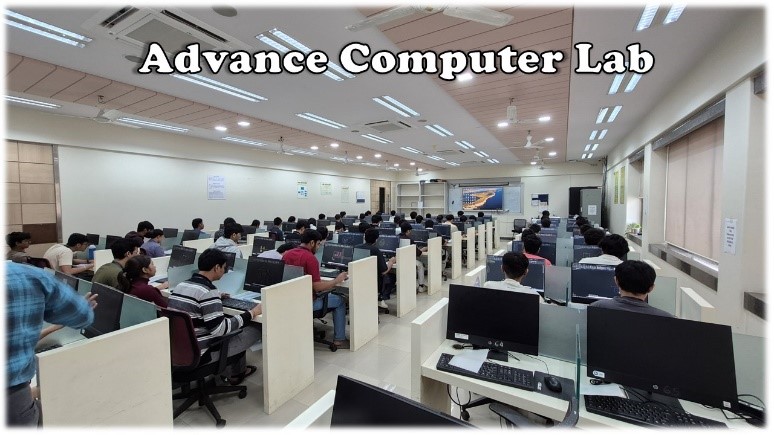
Advance Computer Lab
Structured Programming Using C
To build a strong foundation in programming and problem-solving, the department conducts Structured Programming using C (Theory) and Structured Programming using C (Laboratory)in Semester I, with a primary focus on the C programming language. The laboratory is designed to familiarize students with fundamental programming concepts such as data types, control structures, functions, arrays, pointers, and structures, which are essential for system-level and application-level software development.
The department takes responsibility for equipping students with hands-on coding experience and computational proficiency while emphasizing good programming practices, efficient algorithm design, code optimization, and ethical use of computing resources. Through practical sessions conducted in a well-equipped computer laboratory featuring networked systems, licensed software, C compilers, debuggers, and smart teaching tools, students are trained in program design, implementation, testing, and debugging These sessions ensure that students develop confidence in writing efficient, reliable, and maintainable C programs, preparing them for core engineering applications, and professional software development environments.
Object Oriented Programming using JAVA
To build a strong foundation in programming and problem-solving, the department conducts Object Oriented Programming Laboratory in Semester II, with a primary focus on Java programming. The laboratory is designed to familiarize students with fundamental programming concepts, object-oriented principles, and logical thinking skills that are essential for modern software development and engineering applications.
The department takes responsibility for equipping students with hands-on coding experience and computational proficiency, while also emphasizing good programming practices, code optimization, and ethical use of computing resources. Through practical sessions conducted in a well-equipped computer laboratory featuring networked systems, licensed software, Java development environments (such as IDEs), compilers, debuggers, and smart teaching tools, students are trained in program design, implementation, testing, and debugging. These sessions ensure that students develop confidence in writing efficient, reliable, and maintainable Java programs, preparing them for professional engineering and software development environments.
List of
Hardware
1. Hp 600 AIO, IntelI CoreI i5-10500T CPU @ 2.30GHz 2.30 GHz, Ram 8GB, HDD 500GB, keyboard and mouse
2. Dell Optiplex 5400 IntelI CoreI i5-10500T CPU @ 2.30GHz 2.30 GHz, Ram 8GB, HDD 500GB, keyboard and mouse
3. Cisco router 48 Port
Mathematics
The Mathematics – I and Mathematics – II courses are offered in the first year of the engineering program to establish a rigorous foundation in essential mathematical concepts and computational techniques necessary for higher-level engineering subjects. This course combines tutorial-based problem solving with Scilab-assisted computational exercises, enabling students to bridge theoretical understanding with practical numerical implementation.
Tutorials reinforce conceptual clarity, promote systematic problem solving, and provide a forum for guided practice under instructor supervision. To complement the theory, students utilize the Advanced Computer Lab to implement numerical methods and visualize mathematical concepts using SciLab software. The Mathematics practical sessions are conducted in the Advanced Computer Lab, which provides an optimal environment for computational learning 66 computers with SciLab Software.
List of Equipment
1.Computers:
·Brand & Model: HP ProOne (400 G1 series)
·Quantity: 70+ workstations allowing nearly all students to work individually during lab sessions, promoting hands-on learning without resource constraints.
·Processor: Intel class processor (2.9 GHz) capable of handling numerical computing, software simulation, and data visualization tasks smoothly.
·Memory: 4 GB RAM suitable for running Scilab and other educational software for engineering mathematics.
·Storage: 500 GB HDD sufficient disk space for software installations, datasets, and student project files.
·Operating System: Windows 8.1 Pro 64-bit stable and compatible with educational and scientific software needs.
This
configuration ensures reliable performance for running SciLab and other
computational tools used in Mathematics I and II and supports:
1.HP Laser Printer (Model: HP Laser P3015):
Use: High-quality and high-speed printing of student outputs, assignments, and program scripts.
Benefit: Enables students to print lab reports, graphical outputs, and codes directly from the lab, supporting documentation of practical work.
2. Networking Infrastructure:
Cisco Switch (2960-X Series)
High-performance managed switches ensure fast, stable, and secure network connectivity across all 70+ systems.
Supports lab networking needs, multi-user file access, and centralized internet access for research and downloads.
3. Audio Main Mix (ZED-10):
Use: Audio mixing console for presentations, demonstrations, and interactive teaching sessions.
Benefit: Supports multimedia instruction, especially helpful during interactive teaching using the smart board and demonstrations.
Chemistry
In order to develop a strong foundation in Chemistry, the department conducts theory and practical sessions in Semester I and Semester II. The subject is designed to familiarize students with the fundamental principles of chemistry that are essential for understanding material behaviour, chemical processes, and applications relevant to modern engineering.
The department takes responsibility for equipping students with practical laboratory skills and analytical competence, while also emphasizing strict adherence to safety precautions during the handling, storage, and disposal of chemicals. Through hands-on experiments conducted in a well-equipped laboratory, featuring instruments such as electronic balances, pH meters, conductivity meters, water baths, ovens, magnetic stirrers, UV spectrophotometer, colorimeter, UV cabinet, and smart teaching tools, students are trained not only in experimental techniques and accurate measurements but also in safe laboratory practices, ensuring responsible and professional conduct in engineering environments.
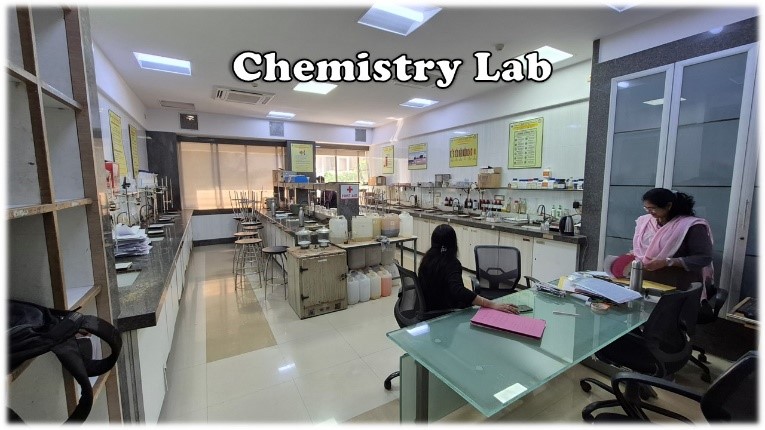
List of Equipment
1. Electronic Balance CB-330
2. Oven
3. Magnetic Stirrer
4. Electronic Balance 600g
5. pH Meter
6. Waterbath Model 17-B
7. Conductivity Meter
8. Equiptronics UV spectrophotometer
9. EQ 650A Colorimeter
10. UV Cabinet 365-254nm
11. Senses Smart board
Physics
The Physics section in our Science and Humanities department forms the bedrock of scientific inquiry, fostering a deep understanding of fundamental principles like mechanics, optics, sensors andelectromagnetism. It plays a pivotal role for engineering students by bridging theoretical concepts with practical applications equipping them with analytical skills essential for innovation in fields like electronics, materials science, and nanotechnology. Through hands-on experiments and students explore real-world problem-solving, enhancing their ability to design efficient systems, optimize technologies, and contribute to interdisciplinary engineering challenges.
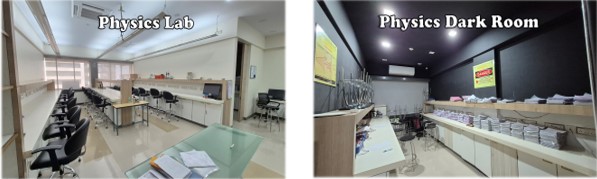
Instruments/ Experimental Kit Available in Physics Lab